📝Abstract
Joint-Embedding Predictive Architectures (JEPAs) underpin a growing family of latent world models for control from raw pixels. Published JEPA world models for pixel-based control (PLDM, DINO-WM, LeWM, V-JEPA-2-AC) each commit at training time to a single inference paradigm, trajectory optimisation in a learned dynamics model, so a checkpoint trained to plan cannot be read off as a policy without retraining. Deferring that choice to inference would let the constraints that bind at deployment, per-step latency and whether a goal observation can be supplied, pick the path. We present Qantara, an end-to-end JEPA of about 21M parameters whose joint training objective pairs a Brownian-bridge interpolant between consecutive clean latents on the state axis with noise-to-data flow matching on the action axis. One checkpoint serves three inference paradigms without retraining: latent planning, behaviour-cloning action sampling, and a video-inverse composition that predicts the next latent without action conditioning, then recovers the action bridging the two. Training samples the two noise levels along the edges of the (action-noise, state-noise) square, one edge per inference dispatch, so each path is trained where it is queried. Replacing that sampler with uniform sampling over the square at matched compute drops Push-T planning from 90.1 to 53.3 success rate (SR). On the LeWM control suite at a matched 10-epoch budget, Qantara averages 91.2 SR over the four environments and reaches 93.7 on OGBench-Cube, +7.7 over DINO-WM and +17.0 over LeWM, each measured against the stronger of that baseline's published score and our retrain of it. From the same weights the two goal-blind paths, which receive no goal image, reach 82.1-83.2 SR on Push-T and 70.8-72.8 on Cube at roughly 15-65x lower inference cost, and fall to near-noise on Reacher, whose released training corpus comes from a random policy.
⚙️Method
Qantara trains a single causal transformer over interleaved action and latent-state tokens. On the state axis it learns a Brownian-bridge interpolant between consecutive clean latents; on the action axis it learns noise-to-data flow matching. The two noise levels (τa, τz) are sampled on the edges of the unit square, exactly the edges each inference paradigm queries at test time. The interior of the square is never used.
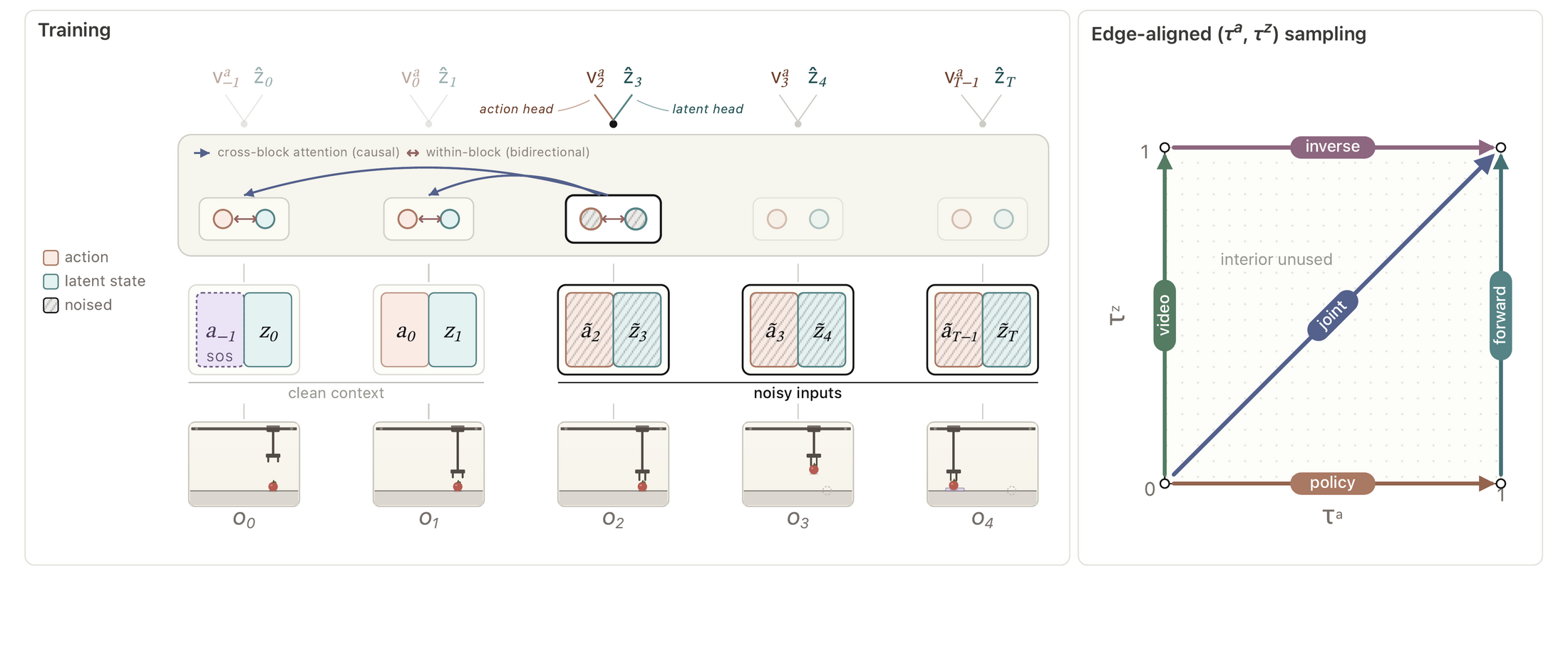
🎛️One Checkpoint, Three Paradigms
Because deployment constraints (rollout budget, whether goal observations are available) differ at test time, Qantara defers the choice of inference path to inference. The same weights serve:
① Latent planning
CEM trajectory optimisation in the learned latent dynamics, the headline goal-conditioned planner.
② Behaviour cloning
Goal-blind action sampling straight from the policy head: no rollout, cheapest inference.
③ Video–inverse
Predict the next latent without action conditioning, then extract the action via inverse dynamics.
📊Results
On the LeWM goal-conditioned planning suite at a matched 10-epoch budget, Qantara's latent planner averages 91.2 SR over the four environments and reaches 93.7 SR on OGBench-Cube.
| Method | Push-T | Two-Room | Cube | Reacher |
|---|---|---|---|---|
| PLDM (published) | 78.0 ± 5.0 | 97.0 ± 1.2 | 65.0 ± 2.8 | 78.0 ± 5.4 |
| DINO-WM (published) | 74.0 ± 4.5 | 100.0 ± 0.0 | 86.0 ± 4.7 | 79.0 ± 5.1 |
| LeWM (published) | 96.0 ± 4.0 | 87.0 ± 2.5 | 74.0 ± 3.0 | 86.0 ± 5.0 |
| PLDM (our repro) | 72.4 ± 1.8 | 96.9 ± 1.0 | 64.5 ± 1.9 | 55.1 ± 1.5 |
| LeWM (our repro) | 92.3 ± 2.0 | 89.9 ± 1.4 | 76.7 ± 1.3 | 64.3 ± 1.7 |
| Qantara (latent planning) | 90.1 ± 1.1 | 100.0 ± 0.0 | 93.7 ± 0.7 | 80.9 ± 1.8 |
Goal-conditioned planning success rate (%), 10 training epochs, 50-step episode budget. The top three rows are reported by the LeWM authors under their pipeline; the bottom three are trained in ours, sharing data, training scaffold and eval budget (mean ± std over 3 training seeds). Bold = unique column-best. Qantara ties DINO-WM at 100.0 on Two-Room, leads on Cube (+7.7 over DINO-WM, +17.0 over the stronger of LeWM's published and reproduced scores), and trails LeWM's published numbers on Push-T and Reacher. From the same weights, the two goal-blind paths (behaviour cloning and video-inverse) reach 82.1–83.2 SR on Push-T and 70.8–72.8 SR on Cube at roughly 15–65× lower inference cost.
📚Citation
@misc{qantara2026,
  title     = {Qantara: Bridge-Flow Training for Multi-Paradigm JEPA Inference},
  author    = {Rakhimov, Ruslan and Bredis, George and Maksyuta, Yuriy and Gavrilov, Daniil},
  year      = {2026},
  note      = {ICML 2026 Workshop on Decision-Making from Offline Datasets to
               Online Adaptation (DEMO); non-archival},
  eprint        = {2607.04978},
  archivePrefix = {arXiv},
  primaryClass  = {cs.LG},
  url       = {https://arxiv.org/abs/2607.04978}
}
🙏Acknowledgments
Built on top of Le-WM and the
stable_worldmodel / stable_pretraining libraries.